Wastewater treatment separates unwanted material from water, but that material still needs to be managed. For businesses operating dissolved air flotation systems, the resulting waste stream is known as DAF sludge.
Understanding what is in your sludge is the starting point for choosing suitable collection, treatment and recovery arrangements. Here’s what businesses need to know.
What is DAF sludge?
DAF stands for dissolved air flotation, a process used to remove suspended solids, fats, oils and grease from wastewater.
Fine air bubbles attach to the material and carry it to the surface, where it is skimmed off as sludge. Some systems also use coagulants or flocculants to help particles bind together and separate from the water.
The sludge contains the separated material, residual water and any treatment chemicals carried through the process. It may be collected as a pumpable liquid or slurry, or undergo further dewatering before removal.
DAF sludge describes how the waste was produced. Its composition determines how it should be managed.
Which industries produce DAF sludge?
DAF systems are used across a range of industrial and commercial settings. Examples include:
- Meat and poultry processing: Treating wastewater containing fats, proteins and suspended organic material.
- Dairy manufacturing: Separating fats and solids from processing wastewater.
- Other food and beverage manufacturing: Managing wastewater generated through production and cleaning activities.
- Pulp and paper manufacturing: Separating fibres and other suspended material.
- Tanneries and chemical processing: Removing material associated with specific industrial processes.
- Oily water treatment: Separating oils and suspended contaminants from wastewater.
The distinction matters because sludge from a food processing facility can have very different characteristics from sludge generated by an industrial chemical process. A treatment pathway suitable for one may be unsuitable for another.
What should businesses consider before arranging disposal?
1. Understand what is in the sludge
Start with the production process and the substances entering the wastewater treatment system.
Useful information includes:
- The source of the wastewater.
- Chemicals used in production, cleaning and wastewater treatment.
- Existing laboratory results or waste assessments.
- Whether other waste streams have been mixed into the sludge.
- Changes in production that could affect its composition.
The receiving facility may require sampling or additional analysis before confirming acceptance. Providing accurate information early helps reduce the risk of rejected loads or unsuitable service arrangements.
2. Confirm classification and acceptance requirements
Waste classification, transport and tracking requirements depend on the material and the relevant state or territory.
In Victoria, for example, businesses arranging industrial waste transport must take reasonable steps to identify and classify the waste, provide sufficient information to the transporter and check that it will go to a lawful receiving place.
Before collection, confirm that the proposed transporter and receiving facility can handle your particular waste stream.
3. Consider water content and collection method
The physical condition of the sludge affects how it can be stored, loaded and transported.
A pumpable slurry may need a different collection arrangement from dewatered sludge. Water content also influences the volume requiring transport.
For some sites, thickening or dewatering may help reduce collection volumes. However, equipment costs, energy use, maintenance, management of the separated liquid and facility acceptance should all form part of the assessment. Dewatering changes the sludge’s physical condition; it does not automatically make it suitable for recovery.
4. Plan storage and collections around operations
Review storage capacity alongside the rate at which sludge is generated.
Consider production peaks, shutdowns, collection lead times and access restrictions. Confirm who monitors storage levels and when an additional collection should be requested.
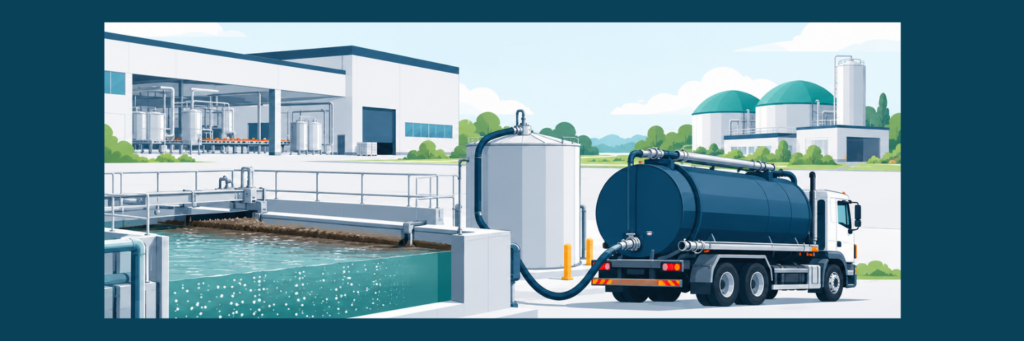
Collection planning should also account for vehicle access, hose distance, loading arrangements and site safety requirements.
5. Review the complete service cost
Compare collection, transport and treatment costs together.
A lower collection rate may offer limited value if it comes with additional waiting charges, a distant treatment destination or a schedule that does not suit production.
Ask what is included in the quote, how quantities are measured and which circumstances may lead to additional charges.
What recovery pathways may be available?
Recovery depends on the sludge’s composition, location and the capabilities and acceptance conditions of available facilities.
Anaerobic digestion
Suitable organic DAF sludge may be accepted at an anaerobic digestion facility, where microorganisms break down organic material to produce biogas.
Melbourne Water, for example, lists DAF sludge among the organic wastes accepted through its food waste treatment service. Acceptance conditions and exclusions still apply, so suitability needs to be confirmed for the individual waste stream.
Composting and organics processing
Some organic DAF sludges may be suitable for composting through facilities authorised to accept them. This requires assessment of the material, including its moisture content, treatment chemicals and contaminants, against the processor’s requirements.
Specialist material recovery
For certain meat processing sludges, specialist processing may allow separation and recovery of fats or oils. Australian industry research has examined these options, with feasibility depending on the sludge characteristics, processing equipment, scale and site economics.
Where recovery is unsuitable or unavailable, an appropriate treatment and disposal arrangement is still needed.
Speak to Nationwide about what is in your sludge. We can help investigate suitable pathways and coordinate acceptance enquiries with specialist facilities.
Could your DAF sludge arrangements work better for your business?
Clarify your priorities, review your current service and identify opportunities to improve costs, reliability and recovery. Download our free DAF Sludge Solution Assessment, then share it with Nationwide to explore suitable options for your site.
Free fillable PDF — can be completed digitally or printed.
How Nationwide Waste Solutions can help
Nationwide connects businesses with specialist collection and treatment providers, bringing the arrangements together through one point of contact.
We can help you:
- Assess your existing service: Review volumes, collection frequency, access requirements and costs.
- Identify suitable treatment options: Coordinate available waste information and facility acceptance enquiries.
- Explore recovery opportunities: Investigate pathways suited to your sludge and location.
- Align collections with operations: Plan services around production demands and storage capacity.
- Improve oversight: Coordinate available collection records and treatment information.
- Simplify multi-site management: Consolidate local services through central account management and invoicing.
Our liquid waste management services support a coordinated approach to managing DAF sludge alongside your other business waste streams.
Find a suitable pathway for your DAF sludge
Share your sludge source, typical volumes, current collection arrangements and any available waste analysis with our team.
To Contact Nationwide, call 1300 729 922 or complete the enquiry form below to discuss your site.