A busy kitchen. Limited bin storage. Frequent collections. A sustainability target that needs measurable progress.
For businesses managing food waste, on-site processing can look like an attractive solution. But before investing in equipment, there is a more useful question to ask: will it improve how this site manages food waste, from the kitchen through to its final destination?
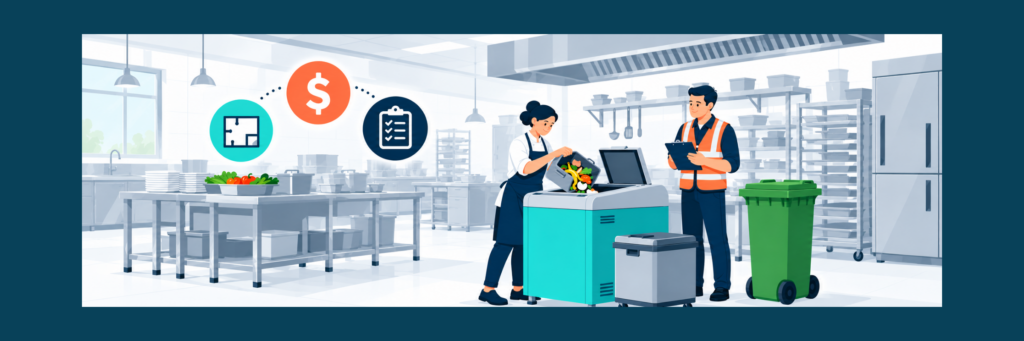
On-site food waste processing makes sense when the equipment suits the waste being generated, staff can manage it consistently, and there is a confirmed pathway for the material it produces. The full operating cost also needs to stack up against other available options.
For facilities, operations and sustainability teams managing multiple locations, that assessment should happen site by site.
Start with the food waste you can prevent
Before choosing how to process food waste, understand why it is being generated.
Preparation scraps, uneaten meals, expired stock and production rejects each tell a different story. Some are unavoidable. Others may point to opportunities to improve purchasing, storage, portion sizes or production planning.
A food waste audit or site assessment can help establish the quantities, composition and operational issues involved.
This also provides a more reliable basis for sizing equipment. Investing around today’s waste volumes without considering prevention could leave a business paying for more capacity than it needs.
Understand what the equipment actually does
“On-site processing” describes several different technologies. Their inputs, operating requirements and outputs vary.
Dehydrators remove moisture from food waste, producing a smaller quantity of dried material. Other systems use biological processes, and some produce liquid outputs.
Dried food waste is not automatically finished compost. It may require further treatment before beneficial use. Understanding the output is just as important as understanding the machine’s capacity.
Before selecting equipment, ask:
- What food types can it accept, and what must be excluded?
- How much can it process within our actual operating hours?
- What solid or liquid outputs does it produce?
- Who will accept those outputs, and under what conditions?
- What ongoing collection or treatment services will still be needed?
Our Beyond the Food Waste Bin webinar recording explores on-site processing, off-site recovery and the practical factors that help businesses assess their options.
Five signs on-site processing is worth assessing
1. Food waste is creating a clear operational problem
On-site processing deserves consideration where storing and moving food waste places pressure on the business.
That might include a constrained bin room, difficult collection access or significant staff time spent handling food waste.
Define the problem first. If the main issue is poor bin placement or an unsuitable collection schedule, an operational change may be enough. If equipment could address a persistent constraint, there is a stronger reason to investigate.
2. Waste volumes and composition are understood
A machine needs to suit both the amount of food waste and the timing of its generation.
An aged care kitchen with regular meal services operates differently from an events venue with sharp peaks or a manufacturer generating batches of production waste.
Assess typical days, busy periods and seasonal changes. Check the equipment’s accepted materials against the actual waste stream, including bones, shells, liquids and packaged products.
Average daily capacity alone will not tell you whether a system can keep up during the busiest shift.
3. The site can support installation and daily use
The equipment footprint is only part of the space requirement.
Teams also need room to load, unload, clean and service the unit, along with storage for incoming waste and processed material. Power, ventilation, drainage and access requirements will depend on the selected technology.
Walk through the complete process with the people who will use it. A suitable location should support kitchen workflow and safe handling, with clear responsibility for daily operation.
4. There is a confirmed destination for the output
Before installation, establish who will receive the processed material and confirm their acceptance requirements.
A reduction in weight or volume does not, on its own, demonstrate recycling or landfill diversion. Reporting needs to account for what happened to the material, including its final destination.
Where a system produces liquid outputs, establish how those will be managed as part of the assessment.
The equipment and the downstream recovery service should be designed together.
5. The full cost supports the investment
Compare the proposed system with an optimised food waste collection and organics recycling service.
Include equipment purchase or hire, installation, utilities, labour, cleaning, maintenance, consumables and remaining collections.
Then test the expected savings. Will collection frequency actually decrease? Can bin capacity be reduced? Will the existing service charges change?
A smaller volume of food waste does not automatically produce a proportionate reduction in invoices. The commercial benefit depends on how the overall service changes.
When off-site collection may be the better fit
A separate food organics collection may be more practical where a suitable recovery service is available and the site has enough storage.
It may also suit locations with low or variable volumes, limited installation space, or teams that cannot reliably absorb additional operating tasks.
Equipment still depends on good separation. Packaging, cutlery and other unwanted materials need to be managed at the point where waste is generated.
Our article on why food waste programs fail explores how contamination, space and behaviour affect day-to-day results.
Pilot before expanding across multiple sites
For a multi-site business, consistent outcomes do not require identical equipment everywhere.
One location may benefit from on-site processing, while another achieves a better result through separate collections and improved bin placement.
Start with a representative pilot and agree on success measures before installation:
- Food waste generated and processed.
- Staff time and ease of use.
- Energy, water and maintenance costs.
- Collection frequency and total service cost.
- Equipment reliability and backup arrangements.
- Confirmed destination of the processed material.
Support the pilot with staff education and training, then use the findings to guide decisions at other locations.
Find the right approach for your sites
The strongest food waste solution connects prevention, separation, processing, collection and reporting into a process your teams can sustain.
Nationwide Waste Solutions helps businesses assess site requirements and coordinate tailored food waste services through our network of industry specialists.
For more insight before you begin, watch Beyond the Food Waste Bin on YouTube.
Find the Right Food Waste Solution for Your Sites
Considering on-site food waste processing? Complete the form below to speak with Nationwide Waste Solutions about your waste volumes, operational needs and recovery options.