Food waste programs usually don’t fail because the concept itself is flawed.
Most businesses understand the goal: separate food waste from general waste, reduce landfill, improve diversion and support sustainability targets. The challenge is what happens after the decision is made.
A food waste program can look simple on paper. Add a food organics bin. Tell staff what goes in it. Arrange a collection. Done.
In practice, it is rarely that easy.
For a food waste program to work, it needs to fit the way a site actually operates. It needs to account for kitchen workflow, bin room space, staff turnover, contamination risk, collection frequency, reporting and contractor capability. When those pieces are not properly designed, food waste programs can quickly become messy, unreliable and difficult to sustain.
That matters more now than ever. Australia wastes around 7.6 million tonnes of food each year, costing the economy more than $36.6 billion annually and contributing around 3% of national greenhouse gas emissions. Australia has also set a national target to halve food waste by 2030.
In NSW, food waste separation is also becoming a compliance issue for many businesses. From 1 July 2026, relevant businesses and institutions that sell or handle food must begin separating food waste from general waste, with a staged rollout based on weekly residual waste bin volumes.
So, why do food waste programs fail?
In our experience, three issues sit behind most problems: contamination, space and behaviour.
-
Contamination: the fastest way to derail a food waste program
Contamination is one of the biggest risks in any food organics program.
The issue is not just that the wrong item ends up in the wrong bin. The real problem is what that can do to the entire waste stream.
Food organics collections rely on the material being clean enough to be processed. Depending on the receiving facility, food waste may be turned into compost, soil products, energy or another beneficial output. If the load contains plastic packaging, cutlery, gloves, straws, coffee cups, general rubbish, glass or non-approved liners, the material may no longer be suitable for recovery.
That can result in extra handling costs, rejected loads or the material being redirected to landfill.
The NSW EPA’s guidance for food organics is clear: food waste bins should only include food, approved compostable kitchen caddy liners that meet commercial composting standards, or fibre-based liners such as paper or newspaper. Everything else belongs in another stream.
This is where many programs come unstuck.
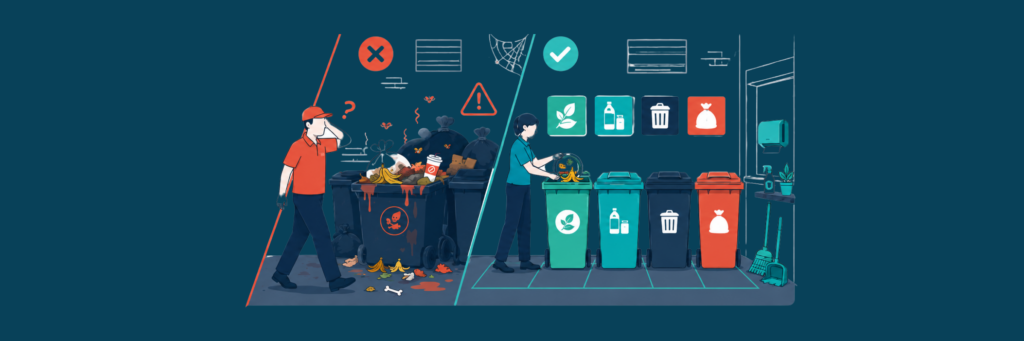
A staff member sees the word “compostable” on packaging and assumes it can go in the food waste bin. A customer drops a plastic fork into the wrong lid. A cleaner uses the wrong liner because it is the one available in the storeroom. A busy kitchen team scrapes plates quickly and does not have time to separate napkins, sauce sachets or packaging.
None of these actions are unusual. They are signs the program has not been designed around real behaviour.
Common contamination causes
Food waste contamination is often caused by:
- unclear signage
- inconsistent bin colours or lid colours
- bins placed too far from the point of waste generation
- staff not knowing which liners are approved
- packaging being mixed with food scraps
- customers using back-of-house systems
- cleaning teams emptying caddies into the wrong bins
- language barriers or limited training
- no regular monitoring or feedback
The fix is not simply “tell people to do better”.
A better approach is to make the right action obvious, easy and repeatable.
That means using simple signage, placing food waste caddies where food is actually prepared or scraped, matching internal bins to external services, standardising liners, and regularly checking contamination before it becomes a bigger issue.
For multi-site organisations, consistency is even more important. If every site has a different bin setup, different signage and different instructions, contamination becomes much harder to control.
-
Space: the operational issue that gets underestimated
Space is one of the most common reasons food waste programs become difficult to maintain.
Food waste is heavy. It can smell if it is not collected frequently enough. It often needs to be moved from kitchens, prep areas, dining spaces or production zones into a bin room or loading dock. That means the program must work physically, not just environmentally.
The NSW EPA recommends placing bins and buckets near where food waste is generated, using containers that are small enough for staff to lift safely, scheduling frequent transfers so bins do not become too full, and considering wheelie bins where space allows.
This is a practical point many businesses miss.
A food waste program that works in a large hotel kitchen may not work in a small café tenancy. Aged care homes, schools, shopping centres, hospitality venues, supermarkets and food manufacturers all have different space constraints.
Some sites have loading docks. Some have shared bin rooms. Some have narrow corridors. Some have limited access times. Some have multiple kitchens. Some operate 24/7. Some rely heavily on cleaning contractors or casual staff.
If the bin configuration does not suit the site, the program creates friction.
And when there is friction, people work around the system.
Food scraps start going back into general waste because the organics bin is too far away. Caddies overflow because they are too small or not emptied often enough. Wheelie bins become too heavy to move safely. Bin rooms become cluttered. Odour complaints increase. The program becomes something staff tolerate rather than support.
If you’re seeing these issues across your sites, it may be time to review how your food waste program is set up and whether it’s truly working for your operations.
Space planning questions to ask before rollout
Before launching a food waste program, businesses should ask:
- Where is food waste actually generated?
- How many food waste points are needed across the site?
- Who will transfer internal caddies to external bins?
- How often will internal bins need to be emptied?
- Is there enough space in the bin room for an additional stream?
- Can the external bin be safely accessed by staff and collection vehicles?
- Will the bin size create manual handling risks?
- Is bin washing or more frequent collection required?
- Does the site need a different solution during peak periods?
These questions are not minor details. They are the difference between a program that works and one that quietly collapses after a few weeks.
-
Behaviour: the hardest part of any waste program
Most waste problems are behaviour problems.
That does not mean anyone is to blame. It simply reflects that people are busy, under pressure and working within existing habits.
In a commercial kitchen, food production environment, aged care home or hospitality venue, waste separation is rarely someone’s main job. It happens while meals are being prepared, residents are being served, stock is being unpacked, dishes are being cleared or cleaning is underway.
If the system is confusing, inconvenient or poorly explained, people will default to the quickest option.
Usually, that means general waste.
This is why education needs to be practical. A one-off email or poster is rarely enough. Staff need to know what the program is, why it matters, what goes in each bin, what does not, and what to do when they are unsure.
More importantly, the program needs to survive staff turnover.
Many businesses train the team during rollout, then assume the job is done. But in sectors like hospitality, aged care, retail, education and cleaning, staff changes are constant. Without refreshers, onboarding materials and simple site-level instructions, knowledge fades quickly. This is where ongoing education makes a real difference — providing clear, practical guidance that can be easily rolled out across sites helps keep teams aligned and programs performing as intended.
Behaviour change works best when it is built into the system
A successful food waste program should make correct behaviour easier than incorrect behaviour.
That means:
- placing food waste bins beside prep benches, dishwashing areas and plate-scraping zones
- using clear visual prompts instead of text-heavy signage
- keeping accepted items simple
- removing unnecessary packaging before food reaches the waste point
- training kitchen, cleaning and facilities teams together
- giving site managers feedback on contamination and diversion
- recognising sites that improve
- reviewing performance regularly, not just at rollout
For multi-site businesses, behaviour change also depends on visibility. Head office needs to know which sites are participating properly, which sites are struggling, and where the program needs adjustment.
Without reporting, food waste programs can appear successful simply because the bins are being collected. But collections alone do not prove that the right material is being recovered.
The hidden issue: treating food waste as a bin change, not a system change
The biggest mistake businesses make is treating food waste separation as a bin change.
It is not.
It is an operational change.
It affects purchasing, food preparation, cleaning, facilities management, contractor coordination, reporting and sustainability performance. It also affects compliance in jurisdictions where food organics separation is mandated or becoming mandatory.
That is why the most successful programs are designed before bins arrive on site.
A strong food waste program should include:
- a site assessment
- stream mapping
- clear bin infrastructure
- suitable collection frequency
- contamination controls
- approved liners and signage
- staff training
- reporting
- ongoing optimisation
This is especially important for organisations with multiple locations. A single-site solution may be easy to adjust manually. A national or multi-site program needs structure, consistency and oversight.
Without that, each site starts solving the problem differently. That creates inconsistent data, inconsistent service levels and inconsistent outcomes.
What good looks like
A well-designed food waste program should feel simple at site level and structured at management level.
For site teams, it should be clear:
- where food scraps go
- what is not accepted
- who empties internal caddies
- when external bins are collected
- what to do if there is a problem
For head office, it should provide visibility over:
- service delivery
- contamination issues
- landfill diversion
- cost impacts
- site-level performance
- improvement opportunities
- contractor accountability
That combination matters. Food waste programs need local behaviour and central governance working together.
How Nationwide Waste Solutions supports food waste programs
At Nationwide Waste Solutions, we help businesses move beyond simply adding another bin.
Our role is to help design food waste systems that work in real operating environments. That includes assessing site requirements, coordinating the right service partners, supporting bin and signage setup, helping manage contamination risk, and providing reporting that gives businesses clearer visibility across their waste streams.
Because we work across a national network of vetted service providers, we are not limited to one fixed infrastructure model. That allows us to help match each site with a practical solution based on location, volume, access, collection requirements and downstream processing options.
For multi-site organisations, that visibility is critical. Food waste performance should not sit in separate spreadsheets, invoices and contractor reports. It should be part of a consolidated waste management program that helps procurement, facilities, operations and sustainability teams understand what is happening across every site.
Final thought: food waste programs fail when they are too hard to follow
Food waste separation is not just about sustainability intent. It is about execution.
The best programs are simple enough for busy teams to follow, practical enough for each site to maintain, and structured enough for head office to measure.
Contamination, space and behaviour are not side issues. They are the program.
Get them right, and food waste can become a valuable recovery stream.
Ignore them, and even the best-intentioned program can end up back in general waste.