
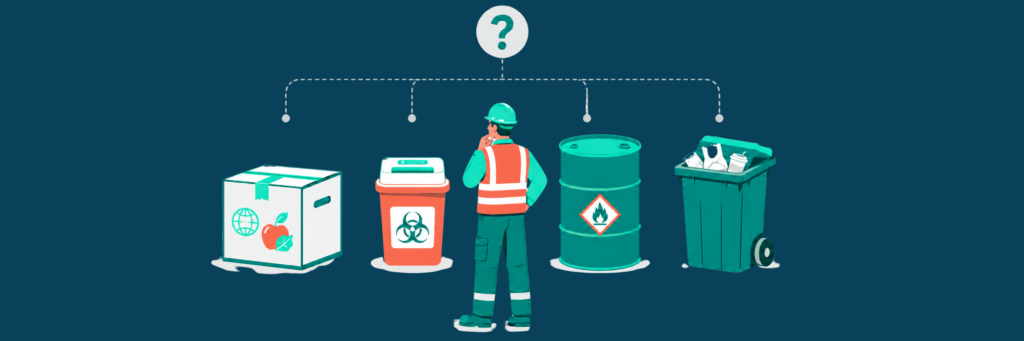
A sealed bag of imported food, a container of laboratory waste and a drum of chemical residue clearly require more care than ordinary office rubbish.
But the difference between biosecurity waste, clinical waste, hazardous waste and general waste is not always obvious.
Packaging, disposable gloves, spoiled products, cleaning materials and contaminated equipment can look like everyday rubbish. However, their source, contents and contamination history may mean they require a completely different disposal pathway.
Incorrect classification can lead to unsuitable storage, rejected collections, unnecessary costs and waste being sent to a facility that is not authorised to receive it.
This guide explains the main differences, where the categories overlap and what businesses should consider before arranging disposal.
Why correct waste classification matters
Waste classification affects how material should be:
- Segregated and contained
- Labelled and stored
- Collected and transported
- Treated or destroyed
- Documented and reported
- Received by an appropriately authorised facility
Requirements vary between Australian jurisdictions. Businesses may need to consider Commonwealth biosecurity controls as well as the state or territory waste rules applying where the material is generated, transported and treated.
In Victoria, for example, organisations that generate, collect, transport, store, process or dispose of industrial waste must classify it and meet the duties applying to that classification.
Where the waste stream or site setup is unclear, a waste audit or site assessment can help identify unsuitable bin use, segregation gaps and services that may need specialist review.
What is biosecurity waste?
Biosecurity waste is material subject to controls intended to prevent pests and diseases from entering or spreading within Australia.
Many businesses still use the term quarantine waste, particularly when referring to waste generated from imported goods, ports, airports, freight operations and approved arrangement sites.
Potential examples include:
- Imported food, plant or animal material
- Soil, seeds and organic contaminants
- Waste produced while inspecting or processing controlled goods
- Packaging, wrapping and dunnage that contacted controlled goods
- Spill-cleaning materials and disposable protective equipment
- By-products or residues from imported products
Imported goods identified as a biosecurity concern remain under biosecurity control until formally released. By-products, waste products and items that have contacted controlled goods including packaging, wrapping and handling equipment—may also become subject to biosecurity control.
This is why biosecurity waste cannot be identified by appearance alone.
A cardboard box may normally be recyclable, but its disposal pathway can change if it has been contaminated by controlled material.
Businesses handling imports should ensure that their biosecurity or quarantine waste services are suitable for the material, service location and applicable regulatory direction.
What is clinical waste?
Clinical waste generally arises from medical, healthcare, veterinary, laboratory and related activities.
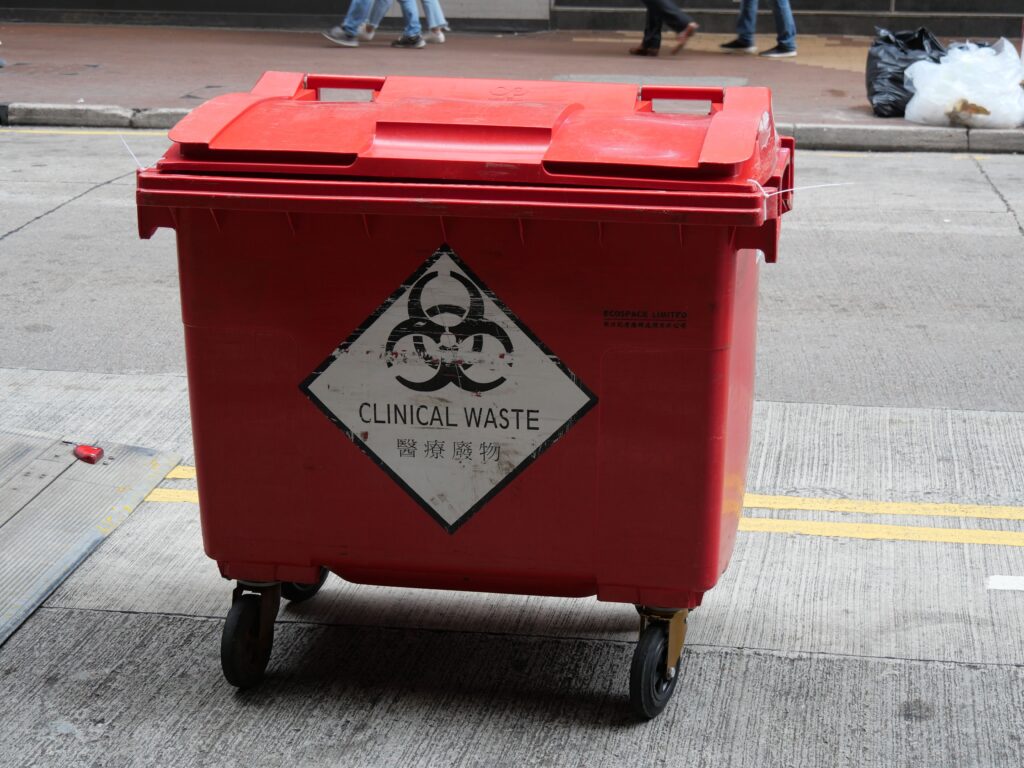
Its primary concern is the potential for infection, biological exposure, sharps injury or harm from particular medical and pharmaceutical materials.
Examples may include:
- Used needles and other sharps
- Blood-contaminated materials
- Human tissue
- Laboratory cultures
- Certain pharmaceutical waste
- Infectious veterinary waste
- Materials contaminated with bodily fluids
Definitions and classifications vary between jurisdictions.
Clinical and related waste may require specialist containers, secure storage, controlled transport and treatment before final disposal.
Businesses operating in hospitals, medical centres, laboratories, aged care facilities and veterinary environments should use an appropriate medical and clinical waste service rather than placing these materials into a standard commercial bin.
Clinical waste is not automatically biosecurity waste. However, imported biological samples, diagnostic materials or veterinary products may be subject to both classifications.
What is hazardous waste?
Hazardous waste presents risks because of its physical, chemical or toxic properties.
It may be flammable, corrosive, reactive, poisonous or harmful to people and the environment.
Examples may include:
- Solvents and thinners
- Acids and alkalis
- Pesticides
- Flammable liquids
- Toxic chemicals
- Certain paints and coatings
- Chemical laboratory waste
- Contaminated absorbents
Hazardous chemical classification can help identify a material’s properties, but it does not replace waste classification.
Transport, storage and waste-management requirements may involve separate regulatory systems. Businesses should consider the material’s contents, concentration, physical form and relevant state or territory requirements.
A waste stream can also be both biosecurity-controlled and hazardous.
An imported pesticide, chemical product or contaminated absorbent may require a chemical and hazardous waste disposal solution that addresses every applicable risk—not simply the easiest classification.
What is general waste?
General waste is ordinary, non-recoverable commercial waste that has been assessed as suitable for a standard general waste service and is not subject to a more controlled classification.
It may include:
- Non-recyclable office waste
- Uncontaminated packaging
- General amenity waste
- Non-hazardous disposable items
- Materials that cannot be recovered but are lawful to place in general waste
The important word is assessed.
An item should not enter general waste simply because it looks harmless.
Gloves, plastic film, cardboard, absorbent material and food products may require controlled disposal if they have contacted biosecurity, clinical or hazardous material.
A standard general waste collection should only be used when the material is suitable for that stream.
Biosecurity waste vs clinical, hazardous and general waste
| Waste Category | Primary Concern | Common source | Main disposal |
|---|---|---|---|
| Biosecurity waste | Preventing the introduction or spread of pests and diseases | Imports, freight, ports, laboratories and controlled goods | Biosecurity containment, approved activities and directed treatment |
| Clinical waste | Infection, biological exposure and sharps risks | Healthcare, veterinary and laboratory activities | Specialist segregation, transport and treatment |
| Hazardous waste | Toxic, corrosive, reactive, flammable or environmentally harmful properties | Manufacturing, maintenance, chemicals and laboratories | Compatibility, regulated transport and authorised facilities |
| General waste | Ordinary non-recoverable commercial material | Offices, amenities, retail and warehouses | Standard collection only where no controlled classification applies |
Where waste classification overlaps
The most difficult situations are often those where more than one classification applies.
Biosecurity and hazardous waste
An imported chemical, pesticide or contaminated product may remain under biosecurity control while also possessing hazardous properties.
Biosecurity and clinical waste
Imported diagnostic products, biological samples or veterinary materials may present both biosecurity and clinical risks.
Clinical and hazardous waste
Laboratory waste can contain biological material mixed with solvents, preservatives or other hazardous chemicals.
Biosecurity and general waste
Packaging or cleaning materials that would normally enter recycling or general waste may become controlled after contacting imported goods or biosecurity risk material.
Where categories overlap, the correct response is not to select the simplest bin.
The collection, transport and treatment arrangement should account for every applicable risk and requirement.
Five questions to ask before arranging disposal
1. Where did the materials come from?
Consider whether it arose from imported goods, healthcare, laboratories, manufacturing or normal commercial activities.
The source can provide an important first indication of the controls that may apply.
2. What does it contain?
Identify known biological, infectious, toxic, flammable, corrosive or reactive contents.
Review available labels, safety data sheets, import documents and regulatory directions.
3. What has it contacted?
Packaging, equipment, cleaning materials and nearby waste may also require controlled management if contamination has occurred.
Do not assume surrounding material remains suitable for general waste or recycling.
4. Is it subject to direction or procedure?
Goods under biosecurity control should not be moved, processed or discarded outside the applicable direction or approved procedure.
Site employees should understand who must be contacted when an unidentified or potentially controlled material is discovered.
5. Can every provider or facility manager manage it appropriately?
Confirm the collection method, transport capability, treatment pathway, receiving facility and required documentation before the material leaves the site.
A contractor’s ability to collect one specialist waste stream does not necessarily mean it can manage every classification or treatment pathway.
Managing specialist waste across multiple sites
Classification becomes more complex across multiple locations and jurisdictions.
A stream handled one way at one site may require different documentation, providers or service arrangements elsewhere.
This is particularly relevant for distribution centres and logistics facilities handling imported goods and for healthcare and hospital environments managing several controlled waste streams.
A consistent national approach should include:
- Clear escalation procedures for unidentified materials
- Site-specific storage and containment arrangements
- Verified collection and treatment providers
- Defined responsibilities for employees and contractors
- Central access to service and disposal records
- Regular reviews when products, processes or regulations change
The objective is not to give every location an identical service.
It is to establish one reliable governance framework supported by locally appropriate disposal solutions.
How Nationwide Waste Solutions can help
Nationwide Waste Solutions helps businesses coordinate specialist waste services across single and multi-site operations.
We review the material, location and service requirements before connecting customers with appropriately capable providers from our national network.
Our waste consulting services can also help organisations review existing arrangements, identify service gaps and develop a more consistent approach across their property network.
By bringing supplier coordination, documentation and reporting together through one point of contact, we help reduce complexity and improve visibility across the waste-management process.
Unsure which waste category applies?
Do not place unidentified or potentially controlled material into an existing bin.
Isolate it, prevent further contamination and obtain advice before arranging collection. A small classification error at the beginning can create a much larger storage, transport and disposal issue later.
Contact Nationwide Waste Solutions to discuss an appropriate collection and disposal solution for your site or national property network.
This article provides general information only and does not replace regulatory, legal or specialist waste-classification advice. Requirements vary by material and jurisdiction.



Leave a Reply
You must be logged in to post a comment.