Most experienced facility managers know that waste oil, solvents, batteries and tyres should not simply be thrown into a general waste bin.
The more difficult question is whether every location in the business is managing those materials correctly and consistently.
This becomes harder as an automotive or collision repair group grows.
One site may have well-established collection services, clearly labelled containers and accessible disposal records. Another may rely on arrangements made years ago by a former manager, a local contractor or a supplier whose downstream pathway has never been reviewed.
The problem is rarely a complete absence of knowledge.
It is the gap between the waste policy established at a group level and what happens in each workshop every day.
These seven waste streams are particularly useful indicators of whether an automotive waste program is properly controlled:
- Waste oil
- Solvents and thinners
- Paint residues
- Spray-booth sludge
- Batteries
- Coolant and contaminated wash water
- Tyres
The real question is not whether the waste needs special handling
For multi-site organisations, knowing that a material requires a separate service is only the starting point.
Facilities, operations and compliance teams also need to know:
- What is being placed into each container
- Whether different materials are being mixed
- Who collects the waste
- Whether the provider is authorised for the activity
- Which facility receives the waste
- Whether that facility can lawfully accept it
- What records are retained
- Whether the process is consistent across all sites
In NSW, waste generators are responsible for classifying the waste they produce. NSW waste requirements also place responsibilities on generators, transporters and receivers to ensure waste is appropriately transported to a place that can lawfully receive it.
That creates a higher standard than simply confirming that a bin was collected.
1. Waste oil: are other liquids entering the oil tank?
Most automotive businesses already have a waste-oil collection service.
The less obvious issue is what else enters the tank.
Across a group of workshops, employees may have different understandings of whether the oil tank can also accept:
- Brake fluid
- Transmission fluid
- Coolant
- Oily wash water
- Fuel-contaminated liquids
- Solvents
- Oil drained from filters
Combining incompatible materials can affect the waste classification, reduce its recycling value or cause the entire load to be rejected or charged at a higher rate.
The accepted mixture can also differ between processors. A practice approved by one waste-oil collector should not automatically be introduced at every site without checking the requirements of each receiving pathway.
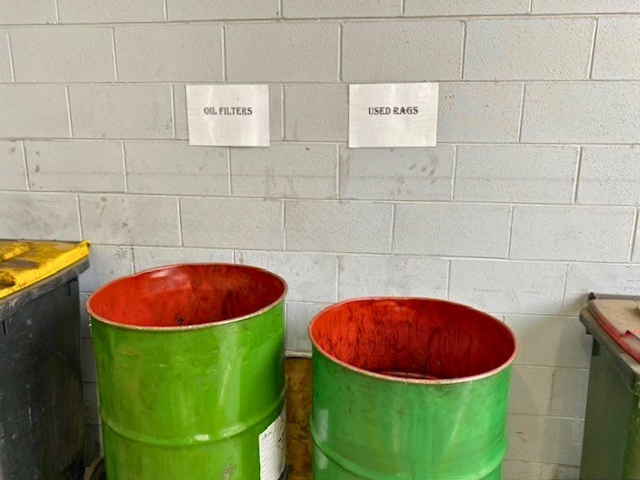
In NSW, an environment protection licence is required to transport waste mineral oil in loads exceeding 200 kilograms.
Questions to ask
- Does each tank display clear instructions about accepted liquids?
- Are coolant and solvent containers located nearby?
- Are workshop staff relying on assumptions rather than documented instructions?
- Can the collector identify the receiving or reprocessing facility?
- Are collection quantities and dockets visible at a group level?
A waste-oil service may be in place at every location while the quality and control of that service still vary considerably.
2. Solvents and thinners: is the process controlled between collections?
A specialist solvent collection does not necessarily mean solvents are being properly managed.
Problems commonly arise before the contractor arrives.
Solvents may be:
- Decanted into unlabelled containers
- Stored with incompatible chemicals
- Left in open containers
- Mixed with paint residues or other liquids
- Accumulated without a clear collection schedule
- Managed differently by individual painters or workshops
The collection service may also have been arranged by a local manager without central confirmation of the contractor, transport requirements or receiving facility.
For a multi-site group, the key control is not simply having a solvent drum. It is having a repeatable process covering generation, storage, collection and documentation.
Questions to ask
- Are all solvent containers labelled consistently?
- Are lids kept closed when the containers are not being used?
- Do sites know which solvent types can be combined?
- Is there a process for damaged or leaking containers?
- Can the business produce evidence of collection and lawful receipt?
- Are solvent volumes monitored to identify unusual usage or waste?
A large difference in solvent waste per repair between similar sites may point to poor inventory control, inefficient cleaning practices or inconsistent segregation.
3. Paint residues: what does each site consider “empty”?
Paint waste is an area where site-level interpretation can create risk.
One employee may consider a tin empty when it can no longer be poured. Another may only place it into a dry-waste stream once the residue has fully hardened. A third site may place all paint containers, mixing cups and contaminated materials into the same bin.
Paint-related waste can include:
- Unused mixed paint
- Partially used products
- Expired paint
- Containers with residual liquid
- Mixing cups
- Paint-contaminated absorbents
- Used spray-booth filters
- Overspray residues
The correct pathway depends on the composition, condition and contamination of the material. The word “empty” is not a sufficient waste classification.
NSW EPA guidance recommends separating mixtures containing different waste classes where this is practical, safe and appropriate.
Questions to ask
- Is there a documented definition of an empty paint container?
- Are liquid residues separated from dry packaging?
- How are booth filters and contaminated absorbents handled?
- Are paint products reviewed before they expire?
- Do similar sites generate significantly different quantities?
- Has the receiving facility confirmed its acceptance criteria?
Better paint-waste management is not only a disposal issue. Accurate mixing, inventory control and product rotation can reduce the amount of paint that becomes waste in the first place.
4. Spray-booth sludge: who owns the process?
Spray-booth sludge can fall between operational responsibilities.
The booth-maintenance contractor may remove it from the equipment. The site team may transfer it into temporary storage. A waste contractor may then collect it weeks later.
When several parties are involved, it can become unclear who is responsible for:
- Identifying the waste
- Selecting the container
- Classifying the material
- Arranging collection
- Confirming the destination
- Retaining disposal records
Sludge may look solid or semi-solid, but its physical appearance does not establish the correct waste class. It may contain paint solids, solvents, metals or other contaminants depending on the products and processes used.
Questions to ask
- Who removes sludge from the booth or sump?
- Where is it placed immediately after removal?
- Is that container compatible with the material?
- Is it protected from weather and vehicle movements?
- Has the waste been appropriately characterised or classified?
- Who retains the collection and disposal evidence?
When ownership is unclear, sludge can remain onsite until a clean-out prompts someone to place it in the nearest available bin.
5. Batteries: has the process kept pace with vehicle technology?
Many automotive businesses have a well-established recycling pathway for conventional lead-acid batteries.
That does not mean the same process is suitable for:
- Lithium-ion batteries
- Hybrid-vehicle batteries
- Electric-vehicle battery packs
- Damaged or swollen batteries
- Batteries involved in vehicle impacts
- Smaller batteries from tools and diagnostic equipment
Battery chemistry, condition, voltage and size can affect storage, handling and transport requirements.
A battery removed from a collision-damaged vehicle may present a different risk from an intact lead-acid starter battery replaced during routine servicing.
In NSW, an environment protection licence is required to transport loads exceeding 200 kilograms of waste lead-acid batteries, and dangerous-goods transport requirements may also apply.
Questions to ask
- Does the site separate batteries by chemistry and condition?
- Is there a defined process for damaged lithium-ion batteries?
- Are batteries protected from impact, moisture and short-circuiting?
- Do employees know who to contact when an unfamiliar battery arrives?
- Has the provider confirmed what it can accept?
- Are electric-vehicle battery arrangements included in group procedures?
The waste program should change as the types of vehicles entering the network change.
6. Coolant and contaminated wash water: where does the liquid actually go?
A national procedure may state that contaminated water must not enter stormwater.
The infrastructure at each site, however, may tell a different story.
Sites can vary in relation to:
- Wash-bay design
- Drainage connections
- Oil-water separators
- Triple-interceptor systems
- Holding tanks
- Sewer approvals
- Trade waste agreements
- Maintenance responsibilities
A drain that appears to be connected to an approved treatment system may have been altered, blocked or incorrectly identified. Changes to site layout or equipment may also have occurred without the waste process being reviewed.
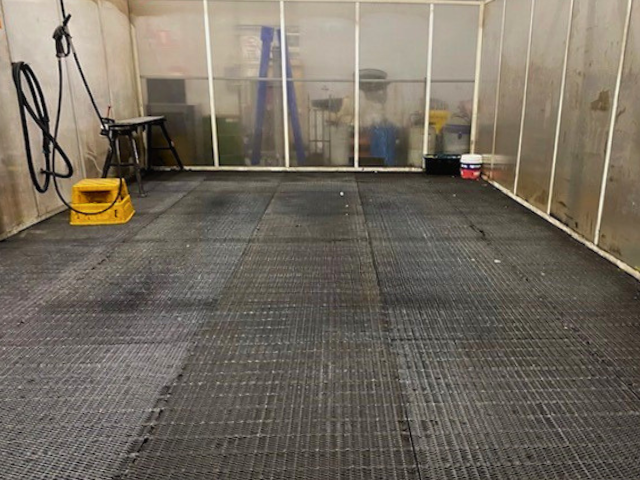
Retained NSW EPA guidance for smash repairers states that approval from the relevant sewerage authority is generally required before wastewater from activities such as car, engine and floor washing is discharged to sewer.
Questions to ask
- Where does each wash-bay drain lead?
- Is the connection documented rather than assumed?
- Is a trade waste agreement required and current?
- Who maintains the separator or interceptor?
- Where do pump-out liquids go?
- Is coolant collected separately from oily water?
- Are service records available centrally?
For a facilities manager, the risk may not be a lack of equipment. It may be that nobody has recently confirmed whether the equipment and approvals still match the site’s current operations.
7. Tyres: can you follow them beyond the collection vehicle?
Tyres often appear to be one of the simplest automotive waste streams.
A local provider collects them, the stockpile disappears and the site receives an invoice.
But central management may still be unable to confirm:
- Who transported the tyres
- Whether all locations use approved providers
- Where the tyres were delivered
- Whether they were reused, retreaded, recycled or disposed of
- Whether collection quantities match site records
- Whether required tracking was completed
Within NSW, consignors, transporters and receivers must use the Integrated Waste Tracking Solution for loads of 200 kilograms or more, or 20 or more waste tyres.
Questions to ask
- Can every site identify its tyre contractor?
- Is the destination visible to the business?
- Are collection records linked to the correct site?
- Are tyres being accumulated beyond safe operational quantities?
- Do collection schedules reflect actual volumes?
- Are contractors selected consistently across the group?
A low-cost local arrangement may not represent good value when it provides limited documentation, visibility or confidence in the downstream pathway.
Why these differences remain hidden
Multi-site automotive groups frequently inherit a mixture of local waste arrangements.
Different sites may use different:
- Contractors
- Container types
- Waste descriptions
- Collection frequencies
- Storage practices
- Approval processes
- Invoice descriptions
- Record-keeping systems
Each arrangement may appear reasonable when considered in isolation.
The risk becomes visible when the business tries to obtain a single, defensible view across the network.
A central team may know the total annual waste spend while remaining unable to determine:
- Which sites generate each regulated stream
- Whether waste classifications are current
- Which collectors and receiving facilities are involved
- Whether tracking requirements are being met
- Where contamination is occurring
- Which materials are being recovered
- Whether similar sites follow the same standards
That is the difference between buying waste collections and managing a waste program.
What should an automotive site waste review test?
A site review should do more than count bins.
It should test whether the documented waste process matches what is happening operationally.
A useful review should examine:
Waste generation
Identify the materials produced by mechanical servicing, collision repair, spray painting, detailing, parts replacement and cleaning.
Point-of-use behaviour
Observe where the waste is created and what employees do with it at that moment. A correctly labelled container is ineffective when it is too far from the work area or difficult to access.
Container suitability
Review compatibility, condition, lids, labels, bunding, weather protection and proximity to drains or vehicle movements.
General waste contents
The general waste bin often reveals missing services and process failures. Batteries, liquid-filled containers, oil filters or paint-contaminated materials may indicate that the appropriate pathway is unclear or inconvenient.
Supplier and facility controls
Confirm who transports each material, what authorisation may be required and whether the destination can lawfully receive it.
Documentation
Review classifications, collection dockets, quantities, tracking records, facility information and certificates of treatment or disposal where relevant.
Performance differences
Compare similar locations. Large variations in waste volumes, service frequency or recovery performance may identify incorrect segregation, inefficient processes or reporting gaps.
Consistent governance does not mean identical services
Every automotive site does not need the same bins or collection schedule.
A high-volume collision repair centre will generate a different waste profile from a mechanical workshop, vehicle dealership or parts-distribution facility.
The objective is not identical services.
It is a consistent management framework that establishes:
- How each waste stream is identified
- Who approves the service provider
- What information must be retained
- How exceptions are managed
- How performance is reported
- How the downstream pathway is verified
- When services and procedures are reviewed
Local delivery can remain flexible while governance, reporting and accountability are managed nationally.
How Nationwide Waste Solutions supports multi-site automotive groups
Nationwide Waste Solutions helps automotive and collision repair groups bring different site arrangements into one managed waste and recycling program.
Through our national network of service partners, we can coordinate general, recyclable, liquid, hazardous and specialist waste streams while providing:
- One point of contact
- Consolidated supplier management
- Site-specific service design
- Consistent service standards
- Consolidated invoicing
- Waste and recycling reporting
- Greater visibility across sites and waste streams
- Contractor performance management
- Support from in-house EPA-accredited expertise
- Identification of recovery and service-efficiency opportunities
We do not assume every location needs the same service.
We help establish the controls needed to give central teams confidence that each site has an appropriate service, a suitable provider and a visible downstream pathway.
Could your sites answer the same seven questions?
For each automotive waste stream, can every location confirm:
- What enters the container?
- What must be kept out?
- Who collects it?
- Where is it taken?
- Can the destination lawfully accept it?
- What records are retained?
- Who reviews the arrangement?
When the answers differ between sites or cannot be produced, the issue is no longer simply waste disposal.
It is a supplier-governance, compliance and operational-visibility gap.
Nationwide Waste Solutions can review your automotive waste arrangements to identify inconsistent practices, unsuitable services, documentation gaps and opportunities to recover more materials across your network.
This article provides general information and does not constitute legal or regulatory advice. Waste classification, storage, transport, tracking and disposal requirements differ between Australian jurisdictions and should be confirmed for each location and waste stream.